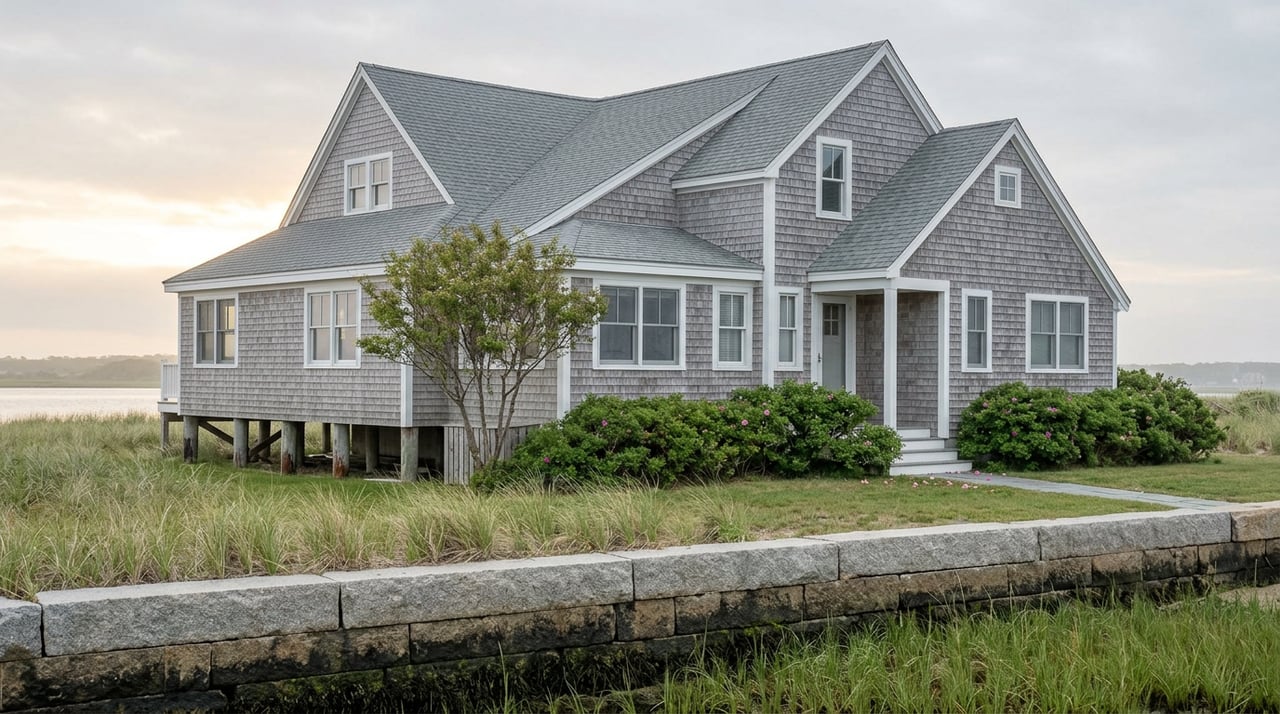
New Castle NH Property Taxes & Flood Insurance: What Changes in 2026?
September 24, 2026
September 24, 2026
The phone at New Castle's town office has been busier than usual this month. Not about the water line work on Walbach Street, and not about the fact that Town Hall itself relocated this summer to the Ocean Street duplex. Residents have been calling about a letter: a preliminary assessment notice from Avitar Associates of New England, the firm the town contracts with to value every parcel on the island. A Zoning Board meeting that was supposed to happen last week got pushed to tomorrow, September 22, and the assessing page on the town's own website is fielding enough questions that the selectboard felt the need to post about it.
If you're watching New Castle from the outside, thinking about buying or comparing it against Rye or Portsmouth on a spreadsheet, none of that shows up in a listing. But it's the most useful thing happening in this market right now, because it's one half of a two-part reset that's landing on New Castle property owners at the same time, and neither half is reflected in the number you'd see on a portal.
New Hampshire law requires every city and town to fully revalue its real estate at least once every five years, so assessed values track actual market value rather than drifting further from it with each passing year. The state's Department of Revenue Administration keeps a public schedule of which town is due when, and New Castle's slot on that schedule is 2026. That five-year ceiling means this cycle's numbers are the first full reset the island has seen in half a decade, and every assessed value on the island is being revisited at once.
A revaluation doesn't automatically raise anyone's tax bill. It redistributes the town's total tax burden according to updated values, so it's entirely possible for a home that appreciated slower than the town average to see its share go down. But it also means homes that appreciated faster than average, which on a peninsula town this size tends to mean waterfront and near-waterfront property, can see a real jump in their assessed value and their bill, even if the town's total budget doesn't grow at all. The preliminary letters going out this month are the first look at where individual properties land.
While the town resets assessed values, a separate and unrelated system is resetting how much it costs to insure the same properties against flooding, and it's already underway.
FEMA's Risk Rating 2.0 replaced the old system of pricing flood insurance by zone with a model that prices each property individually, based on its elevation, its distance to water, how often that specific stretch of coast floods, and what it would cost to rebuild. New Castle sits at the mouth of Portsmouth Harbor, and FEMA's flood maps classify much of its coastline into AE and VE zones, with VE representing the highest risk category because it accounts for wave action on top of storm surge, not just rising water. The threat here isn't hurricanes. It's nor'easters, which can park offshore for days and stack water against the coast through repeated tide cycles rather than one dramatic surge.
New Hampshire's insurance regulators have noted that roughly 35 percent of policyholders statewide will see their premiums go down under the new pricing, while others face increases phased in gradually. For a property close to the water in New Castle, the individualized model is more likely to push the number up, since it's pricing the exposure directly rather than averaging it across an entire zone. It cuts the other way too: elevation and mitigation work can lower a premium under Risk Rating 2.0 in a way flat zone pricing never allowed. And it's worth remembering that a meaningful share of all flood claims nationally come from outside the officially designated high-risk zones, which means a property just outside the mapped AE or VE line isn't automatically in the clear.
Two systems, two different clocks, both recalculating what it actually costs to own a house on this island, and both doing it in the same year.
| Mechanism | Last reset | What's happening in 2026 |
|---|---|---|
| Property tax assessment | 2021 town-wide revaluation | Preliminary letters from Avitar Associates are landing now, per the state's mandated five-year cycle |
| Flood insurance pricing | Flat zone-based rates | FEMA's Risk Rating 2.0 is phasing in individualized, elevation-based pricing |
Part of what makes New Castle attractive on paper is its tax rate. Recent property tax data puts New Castle's effective rate at roughly half a percent, well under both the national median of about 1.02 percent and New Hampshire's own state median of around 1.91 percent. Illustrated another way, a $535,000 home assessed at market value would generate an annual tax bill of roughly $3,070 in New Castle, compared to something closer to $14,369 for the same value home in Concord. That gap is real, and it's a legitimate reason buyers look at this town.
But that rate and that bill are both products of the town's current assessment cycle, a cycle that's about to close out under the state's five-year rule. They're not a permanent feature of New Castle, they're a photograph of the town at a specific moment, and the moment is about to change on two fronts at once. A buyer comparing New Castle's "low taxes" to Rye's or Portsmouth's should understand that the number they're comparing is aging out on the tax side and is being individually recalculated on the insurance side right now.
Even setting aside taxes and insurance, "the median price in New Castle" is a fragile number, because so few homes actually change hands here in any given month. Automated home value estimates put the average New Castle home around $2.47 million as of this past July. A widely used sale-price tracker showed the median sale on the island at $2.1 million in December 2025, down more than 20 percent from a year earlier, a swing driven almost entirely by which one or two homes happened to close that month rather than any real shift in the market. Four months later, a single 4,352-square-foot home on Little Harbor Road sold for $4.9 million, nearly doubling that "median" in one transaction. Around the same period, one listing tracker showed a median list price near $4.47 million with only two active listings on the entire island.
None of these numbers are wrong. They're just each describing a market so thin that a single closing can swing the median by seven figures. If you're comparing New Castle to a town with real transaction volume, the median isn't giving you a market, it's giving you whichever house happened to sell.
Does a town-wide revaluation automatically raise my taxes? Not by itself. A revaluation redistributes the existing tax burden based on updated market values. Your bill moves in relation to how your property's value changed compared to the town average, not because the town is collecting more overall.
If my home isn't in a VE zone, can I ignore the flood insurance changes? Not entirely. A meaningful share of flood claims nationally come from properties outside the officially mapped high-risk zones, and Risk Rating 2.0 prices every property individually rather than by broad zone, so it's worth understanding your specific number even outside AE or VE.
When will New Castle's new assessments be finalized? The preliminary letters going out now are the first step. Property owners can review their values through the town's Avitar Associates assessing kiosk before the final numbers are set later in the cycle.
New Castle's appeal has never really been about a low number on a spreadsheet. It's a small, storied island community at the mouth of a working harbor, and that's worth something no assessment or insurance model captures. But if you're comparing it to another Seacoast town this fall, do it with this year's real numbers, not last cycle's reputation.
If you want a read on what a specific New Castle property is actually likely to look like once both resets land, or you're weighing New Castle against another town on the water, SellingTheSeacoast can walk through the specifics with you. You can also look at the broader New Castle neighborhood guide or start with a free home valuation to see where your own numbers stand before the final letters go out.
Stay up to date on the latest real estate trends.


We are committed to guiding you every step of the way—whether you're buying a home, selling a property, or securing a mortgage. Whatever your needs, we've got you covered.

40 Pleasant St Portsmouth NH 03801